
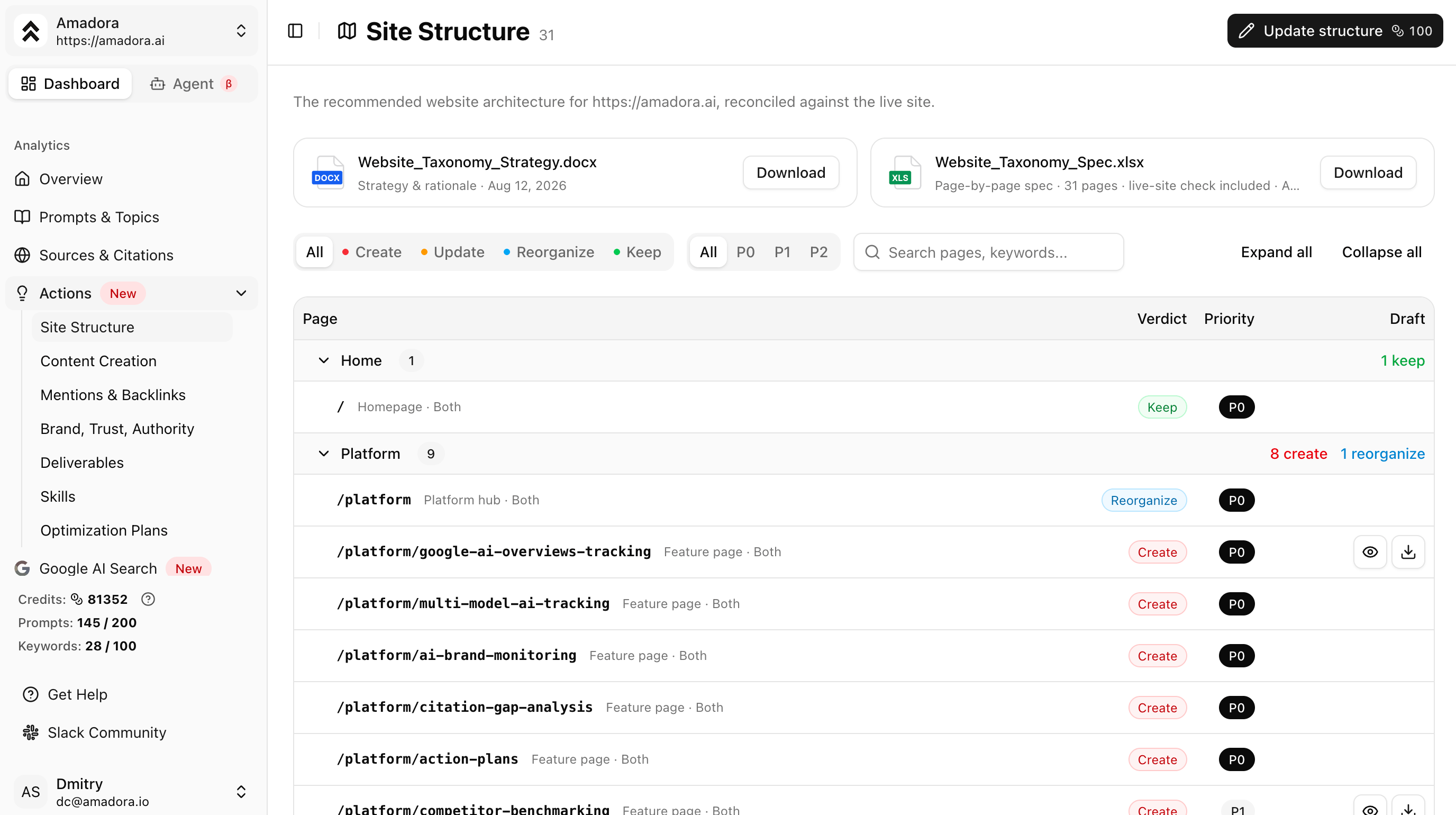
What Site Structure Does
AI engines retrieve information from URLs that focus on specific, well-defined topics. Broad homepages covering multiple services or blog posts acting as product pages are difficult for LLMs to index and cite accurately. Site Structure eliminates architecture bottlenecks by delivering:- Target Architecture: A URL-by-URL structure tailored to your business model.
- Live Reconciliation: A direct comparison between your existing site and recommended pages.
- Draft Generation: One-click landing page draft generation from any row in the spec.
Architecture Generation Logic
Data Inputs
- Project Data: Topical map pillars, cluster topics, search intent, and target business context.
- Competitor Intelligence: Competitor site structures, standalone use case pages, and coverage gaps.
- Live Site Crawl: Real-time scrape of your live website, including sub-sections and blog content.
Decision Engine
- Business-Specific Templates: Automatically adapts architecture to your model (e.g., Platform × Solutions for SaaS, Services × Locations for local business).
- Topic Consolidation: Consolidates related search intents into dedicated URLs corresponding to single buyer decisions. Typical SMB architectures land between 15 to 35 core landing pages.
- Volume Thresholds: Topics under ~200 monthly searches are merged or routed to the blog backlog unless they serve explicit commercial purposes (e.g., comparison pages, pricing, contact).
Understanding Verdicts and Priorities
Page Verdicts
Priority Levels
- P0 (Launch Set): Homepage, primary product/service spine, core audience pages, comparison pages, pricing, contact.
- P1 (Phase 2): Secondary features, niche audiences, glossary hubs, case study hubs.
- P2 (Phase 3): Deep segment pages, regional expansion, programmatic pages.
Deliverables & Exports
Site Structure generates two complete strategy assets available in Deliverables:1. Website_Taxonomy_Spec.xlsx
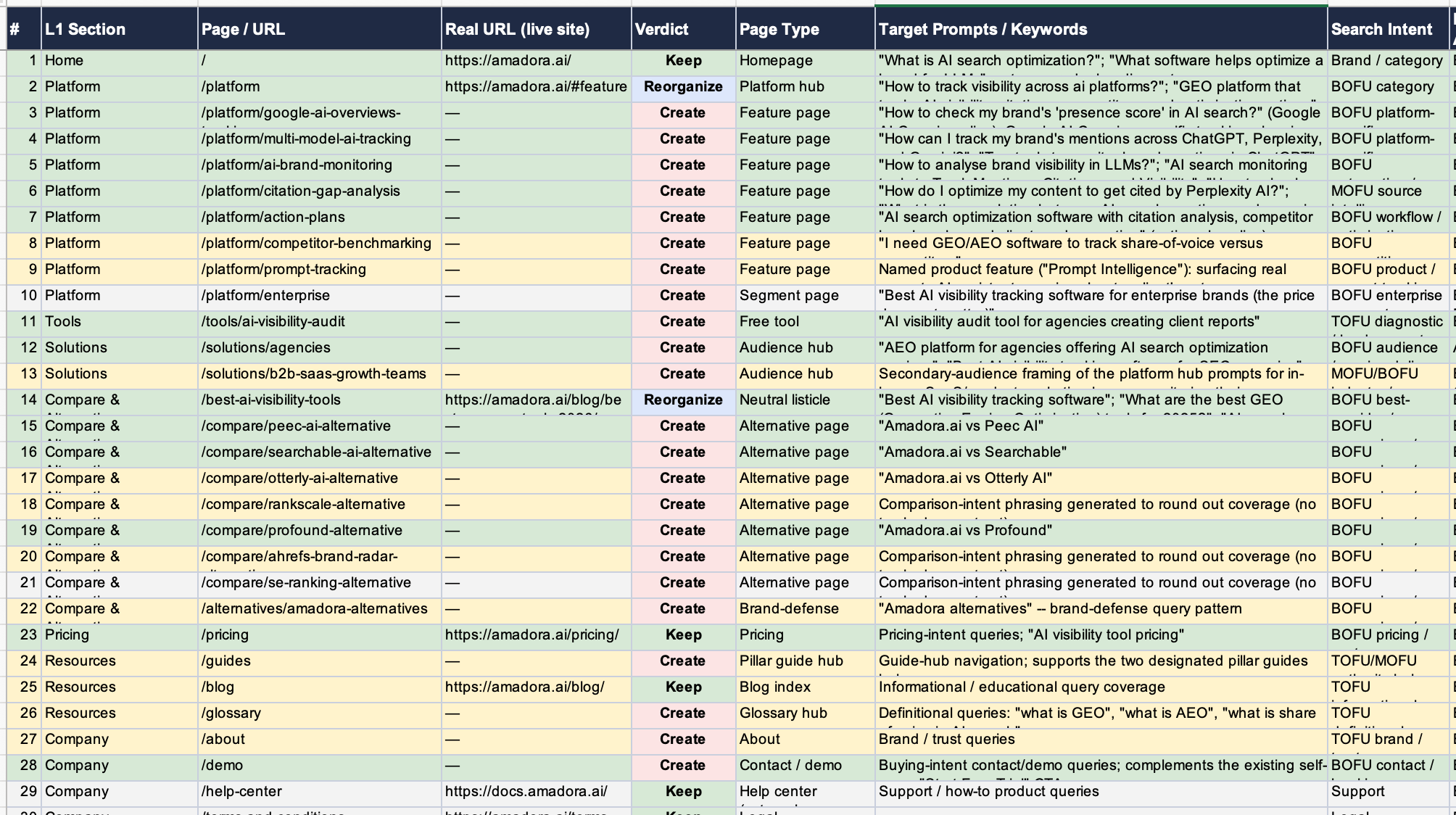
- Sitemap Spec Sheet: Contains L1 section mapping, recommended URLs, live site URLs, verdicts, search intent, primary target prompts, and GEO on-page writing notes.
- Content Backlog Sheet: Identifies low-volume topics routed to the blog rather than landing pages.
- Competitor Gap Analysis: Highlights coverage gaps found on competitor sites.
2. Website_Taxonomy_Strategy.docx
A stakeholder-ready strategy report outlining executive summaries, architecture design principles, competitor benchmarks, and a three-phase build roadmap.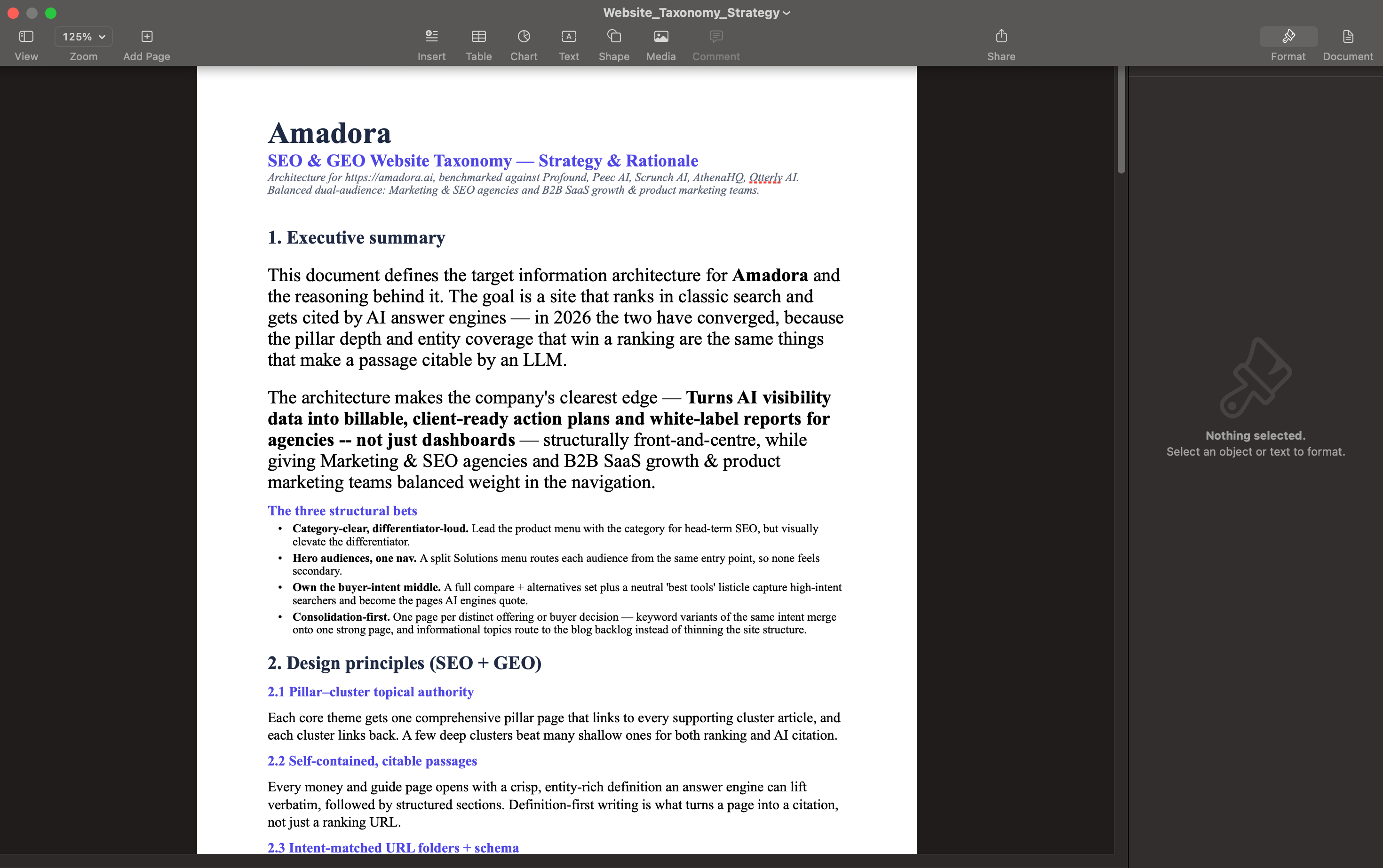
Recommended Execution Workflow
- Execute P0 Reorganize Pages: Move existing content (such as homepage anchors) into standalone URLs. This provides quick visibility wins with minimal content creation effort.
- Build P0 Create Pages: Click Draft on any
Createrow to generate landing page copy, then send to developers. - Refine P0 Update Pages: Follow the GEO notes on each row to fill missing information on existing pages.
- Hand Off Content Backlog: Transfer non-landing page topics to Content Creation to populate your blog schedule.
- Share Strategy DOCX: Send the
.docxdocument to clients or internal teams to explain architectural decisions.
Updating Your Architecture
Click Update structure (100 credits) to issue plain-language revisions to your recommended spec:“Add service landing pages for Austin, Dallas, and Houston, and merge /guides into /resources.”
- Draft Retention: Renaming or updating a page preserves any previously generated landing page drafts attached to that record.
- Manual Override: Custom instructions override default agent consolidation rules.
FAQs
Do I need a topical map before running Site Structure?
Do I need a topical map before running Site Structure?
Yes. The topical map supplies keyword volumes, business context, and pillar hierarchy. It only needs to be generated; no approval step is required.
Why is a page I wanted missing from the spec?
Why is a page I wanted missing from the spec?
It was likely merged into a broader page or moved to the blog backlog. Check the Content Backlog sheet in the spreadsheet export. You can also force page creation using Update structure.
Does Site Structure replace my XML sitemap?
Does Site Structure replace my XML sitemap?
No. It is a strategy document for target architecture. The
Real URL column identifies current live pages so you can plan redirects and migrations.Can I run this without tracked prompts?
Can I run this without tracked prompts?
Yes. Architecture recommendations build from your topical map, competitor analysis, and live site. Adding prompts later adds extra precision to page targeting.