Quick start
Three steps to go from zero to live tracking:- Add your keywords — the search intents you want to monitor (you get 5 for free).
- Wait for the first run — Amadora checks each keyword on Google on a recurring schedule and builds your baseline.
- Open the Overview — read your visibility funnel and the gap insights, then drill into the Keywords view to act.
Step 1 — Add your keywords
What it is. In Google AI Search you track keywords — short Google-style search intents likementoring software for mid-size companies, not the long conversational prompts you’d type into a chatbot. Each keyword is re-checked on a schedule so your metrics stay current.
Why it matters. Your keyword set defines everything the feature measures. Choosing the right intents — the queries your buyers actually type — is what makes the visibility, mention, and citation numbers meaningful. Every account includes 5 keywords by default, so start with your highest-value commercial intents.
There are three ways to add keywords. Use whichever fits how you already work — you can mix and match.
Option A — Add keywords manually
Best for: a handful of known, high-priority queries you already have in mind. Benefit: full control and instant setup — type exactly the intents you care about, no list required.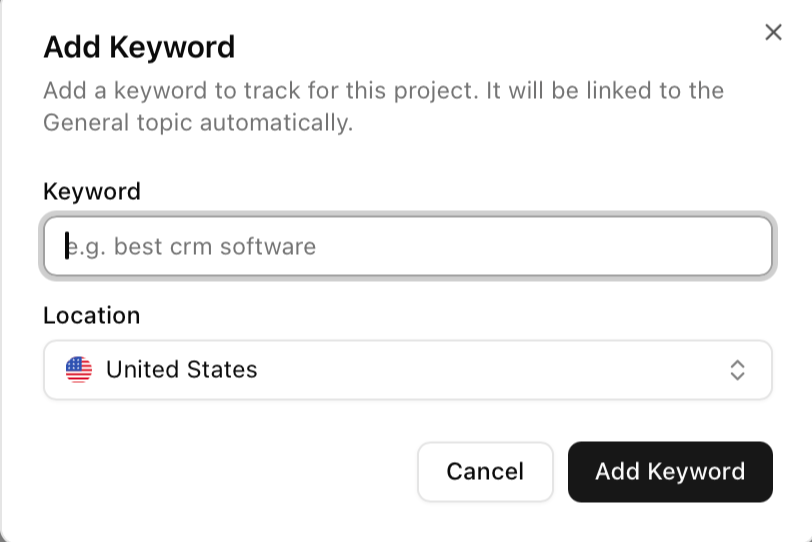
- Open your project and go to Google AI Search.
- Click Add keywords and choose the manual entry option.
- Type one keyword (search phrase) per line.
- Save. The keywords enter the queue and are checked on the next run.
Option B — Pick keywords from the topical map
Best for: covering a whole topic thoroughly without brainstorming every phrase yourself. Benefit: the topical map groups relevant search intents by theme, so you can see the full landscape around your product and select the ones worth tracking — fast coverage, fewer blind spots.- In Add keywords, open the Topical map.
- Browse the suggested keywords, organized by topic.
- Tick the intents you want to track (prioritize commercial and comparison queries).
- Add the selected keywords to your project.
Option C — Import keywords from a CSV file
Best for: bulk-loading an existing keyword list — for example, an export from your SEO tool or a list you maintain in a spreadsheet. Benefit: add many keywords at once instead of typing them in, so migrating an existing research set takes seconds.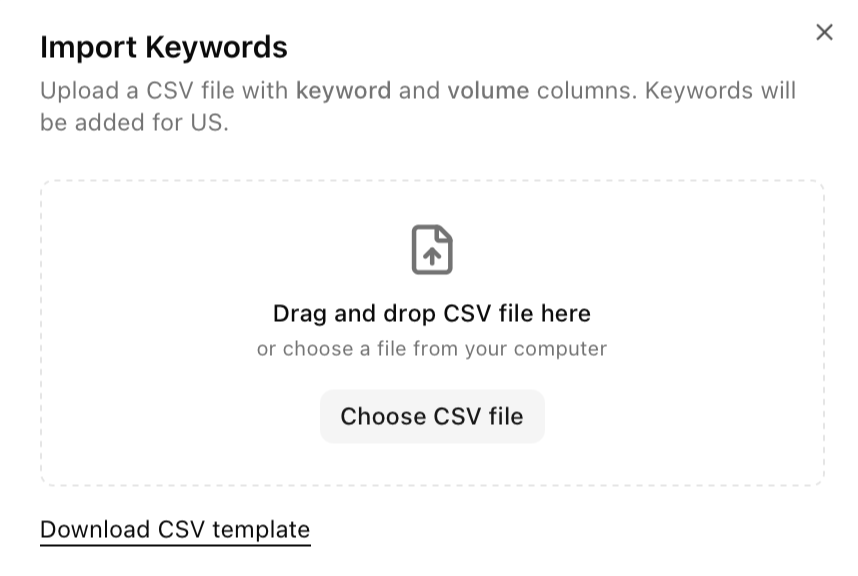
- Prepare a CSV with one keyword per row (a single column of search phrases).
- In Add keywords, choose Import from CSV and upload the file.
- Review the parsed list and confirm.
- The keywords are added and queued for the next run.
Going beyond 5 keywords
To track more, activate the keyword add-on — pricing scales with the number of keywords and starts at $9/month for 15 keywords. The add-on takes effect immediately, so you can expand into longer-tail and competitor-comparison queries whenever you’re ready.Step 2 — Let the first run complete
What happens. Once keywords are added, Amadora runs each one on Google and captures a snapshot of the whole results page — your organic rank, whether an AI Overview appeared, and whether your brand was mentioned or cited in it. Keywords are re-checked on a recurring schedule (shown in the header, e.g. “All keywords run 3 times a week”), so the numbers reflect a repeated sample rather than a single moment. Why it matters. You don’t need to do anything here — but knowing the data is sampled repeatedly explains why metrics firm up after the first couple of runs and why they shift gradually rather than spiking.Step 3 — Read your results
Google AI Search has two views, switched from the top-right toggle. Here’s what each is for.The Overview — your visibility at a glance
What it is. The aggregate health of your whole keyword set: four headline metrics, a competitor comparison, SERP composition, and an automated insights panel. Why it matters. It answers the big questions in seconds — do we show up, does Google show an AI answer, and does that answer mention or cite us? The four metrics form a funnel: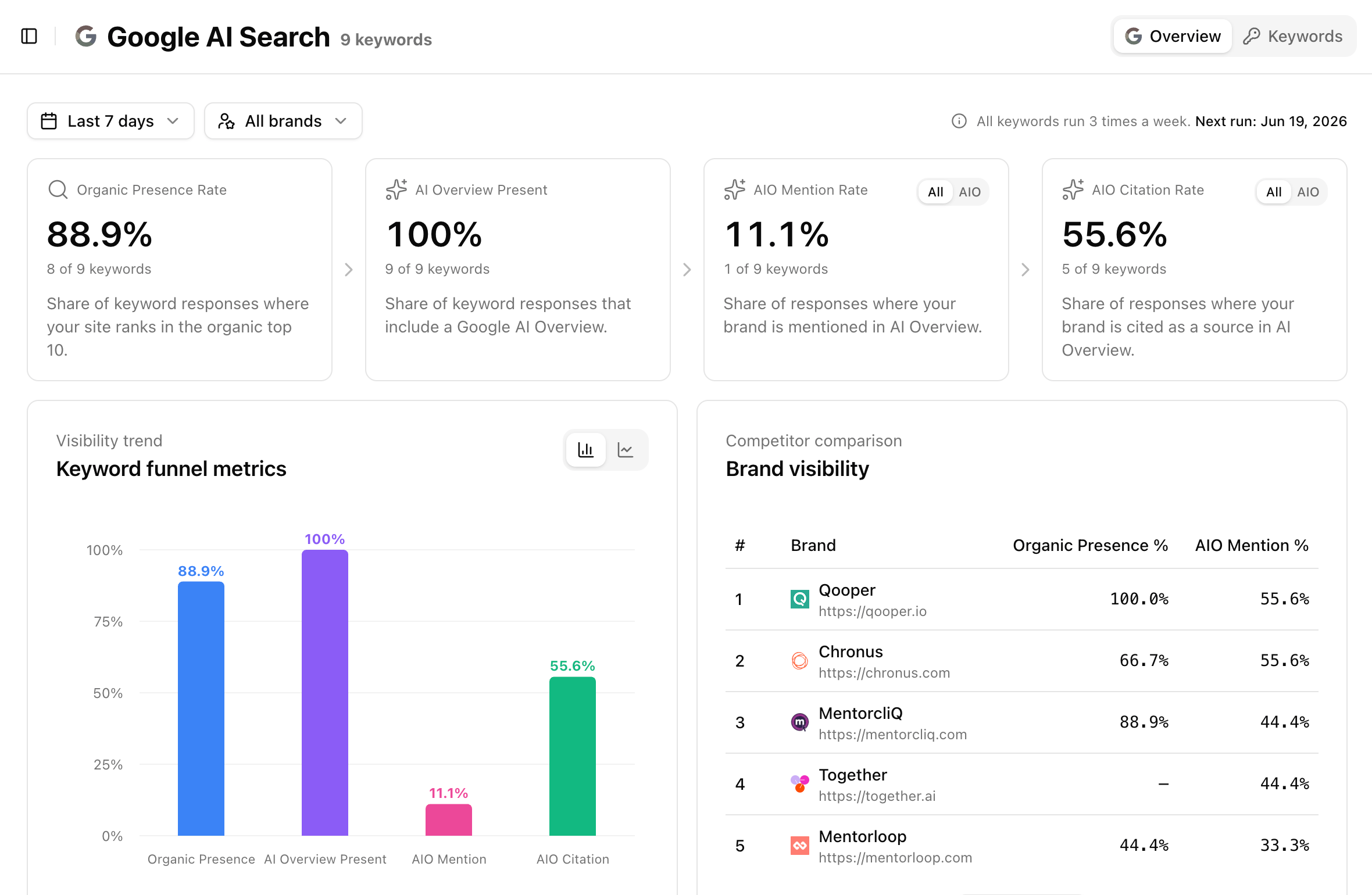
- Organic Presence Rate — how often you rank in the organic top 10.
- AI Overview Present — how often Google shows an AI Overview at all.
- AIO Mention Rate — how often the AI Overview names your brand.
- AIO Citation Rate — how often it cites your site as a source.
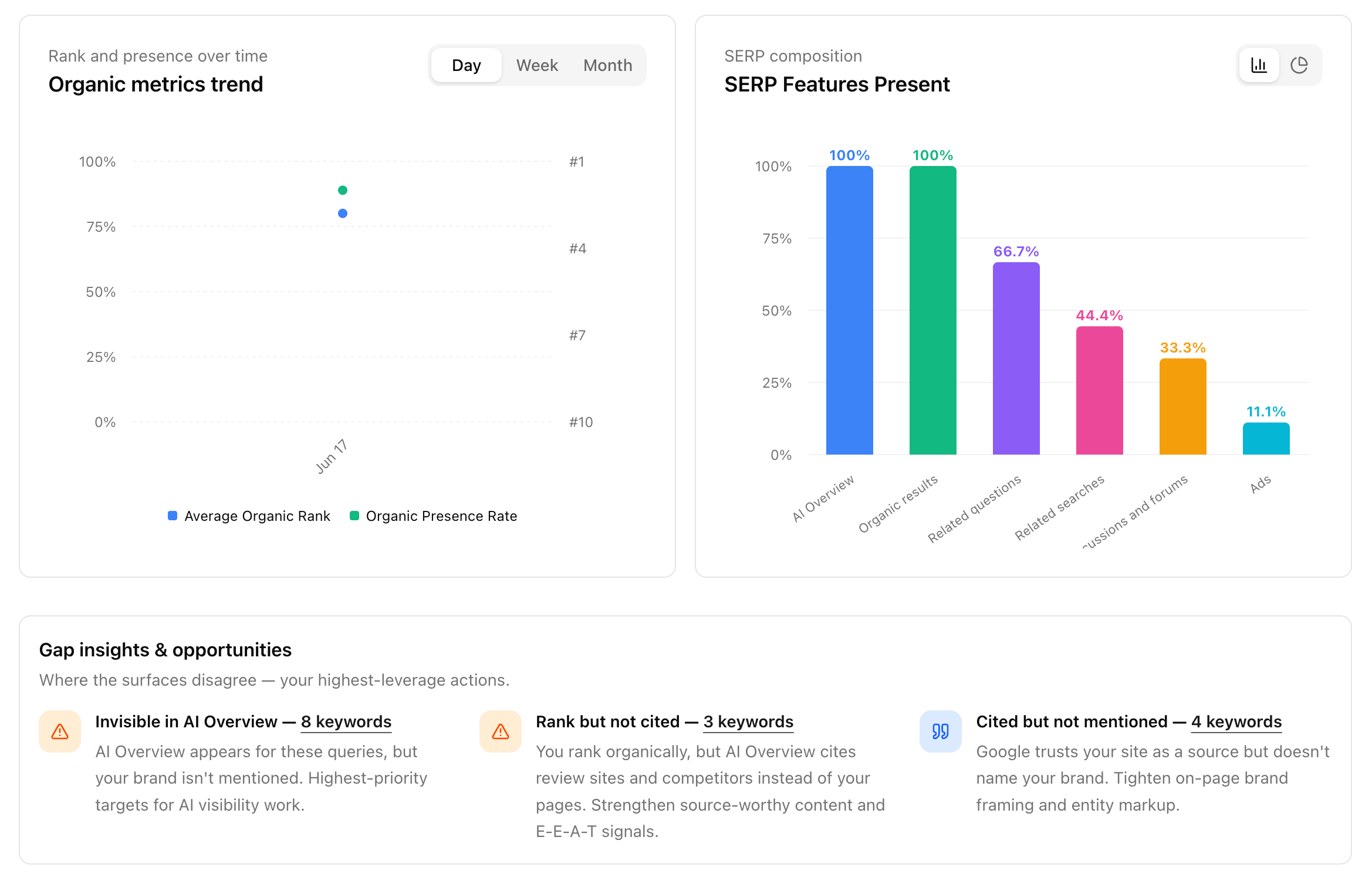
For the precise definition of each metric, the All / AIO toggle, and every gap-insight type, see the Google AI Search — feature reference article.
The Keywords view — find the queries behind the numbers
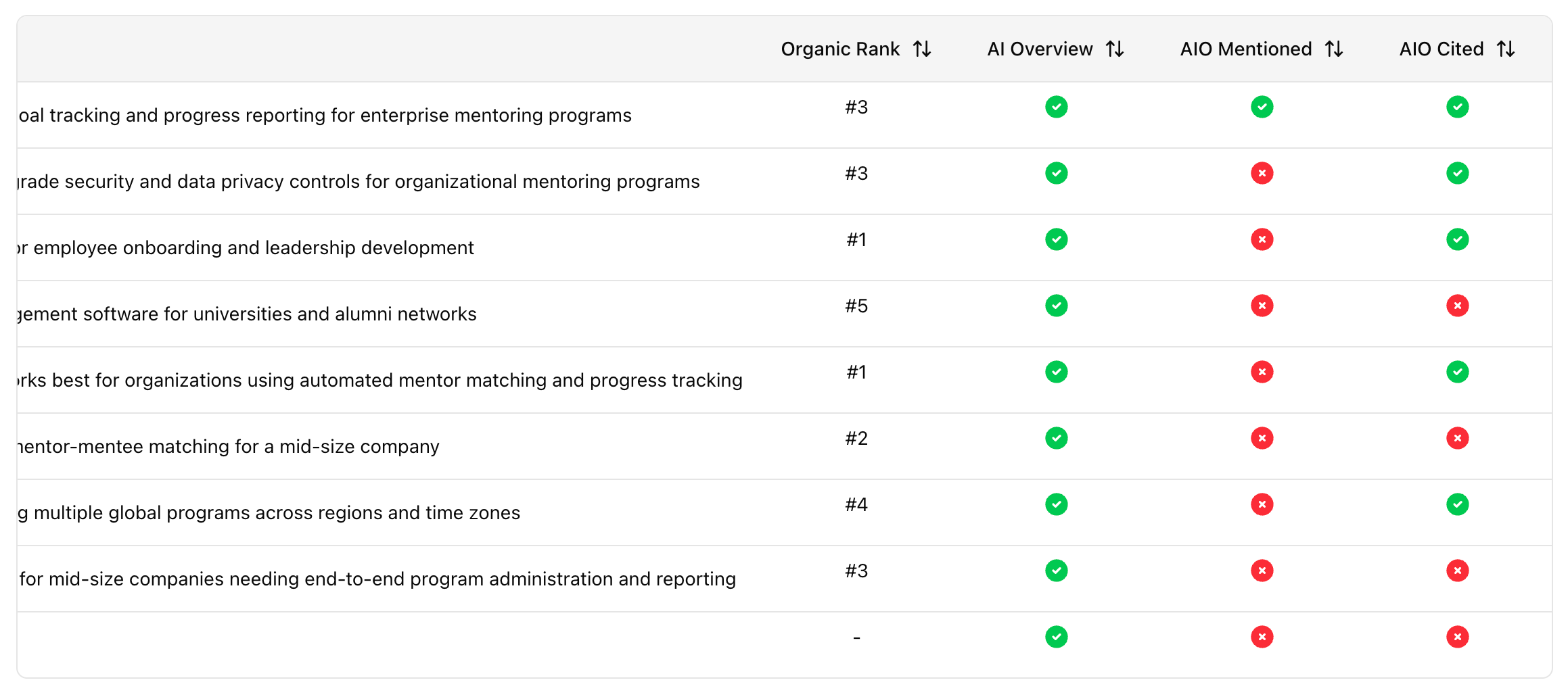
What it is. A per-keyword table with sortable columns: Organic Rank, AI Overview, AIO Mentioned, and AIO Cited.