
Amadora AI tracks your brand’s real-time performance across AI engines like ChatGPT, Perplexity, and Gemini.
Instead of guessing how these models see you, we reverse-engineer their responses to generate four actionable scores:
- Visibility Score: How often you appear.
- Share of Voice: Your dominance compared to competitors.
- Average Position: Your ranking in recommendations.
- Citation Share: How frequently the AI links to your site.
1. Visibility Score
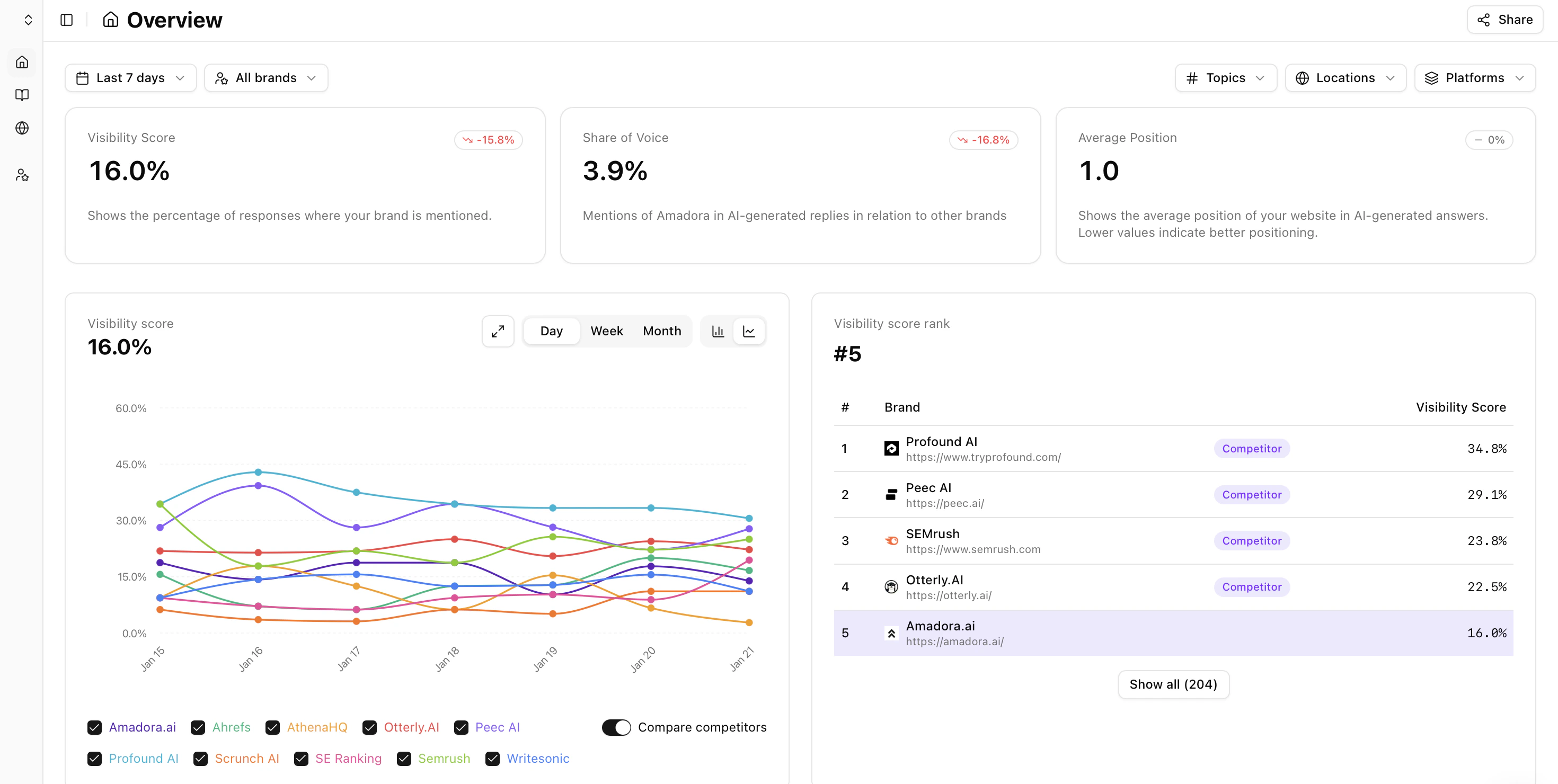
The percentage of conversations where your brand appears.
What it is
The Visibility Score is your baseline metric for brand presence. It answers a simple yes/no question: When a user asks a relevant question, does the AI mention your brand at all?How we calculate it
We run your monitored prompts (questions) through AI engines. If your brand name appears in the text of the response, it counts as a “hit.”- The Formula:
- Example: If we run a prompt 10 times and you appear in 4 answers, your Visibility Score is 40%.
Why it matters
This is your foundational metric. You cannot get traffic or sales from AI if the model does not know you exist. A rising Visibility Score means the AI models are successfully retrieving your brand from their training data or live search results.2. Share of Voice
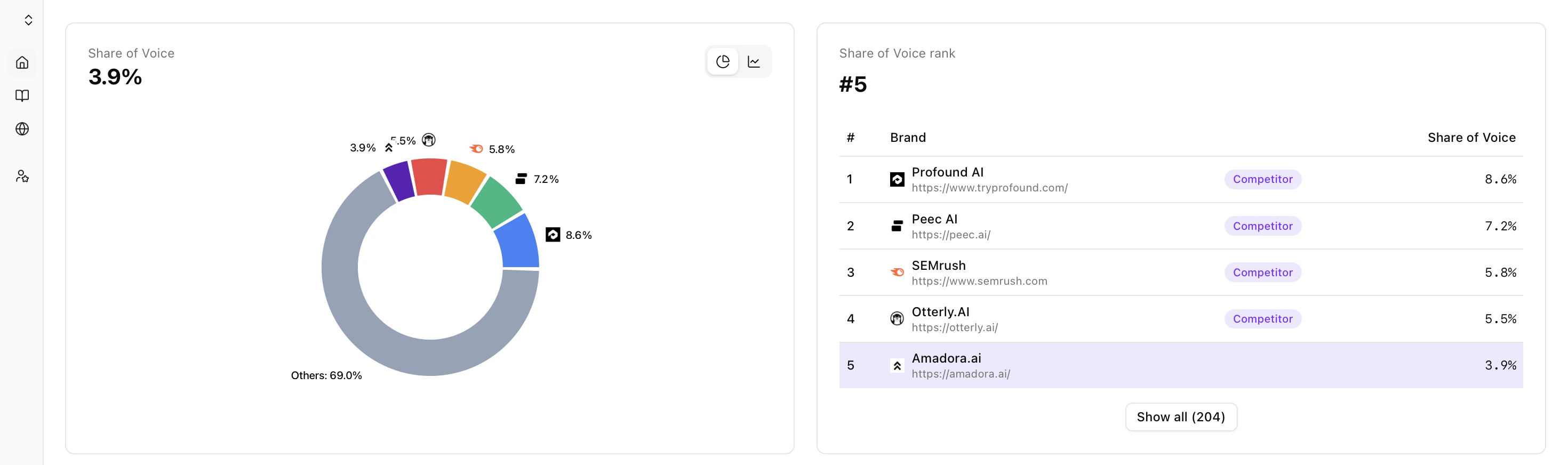
Your dominance compared to the competition.
What it is
Make sure to add competitors to really leverage this feature.
How we calculate it
We count every single brand mention in the answers—yours and your competitors’—to create a “Total Mentions” pool.- The Formula:
- The Example: Let’s say we find 200 total brand mentions in a week.
- You are mentioned 100 times.
- Competitor A is mentioned 75 times.
- Competitor B is mentioned 25 times.
- Your Share of Voice is 50% (100 ÷ 200).
Why it matters
This measures market dominance. You might have a decent Visibility Score (e.g., you appear often), but if your competitors are appearing more often or in the same answers, your Share of Voice will be lower.3. Average Position
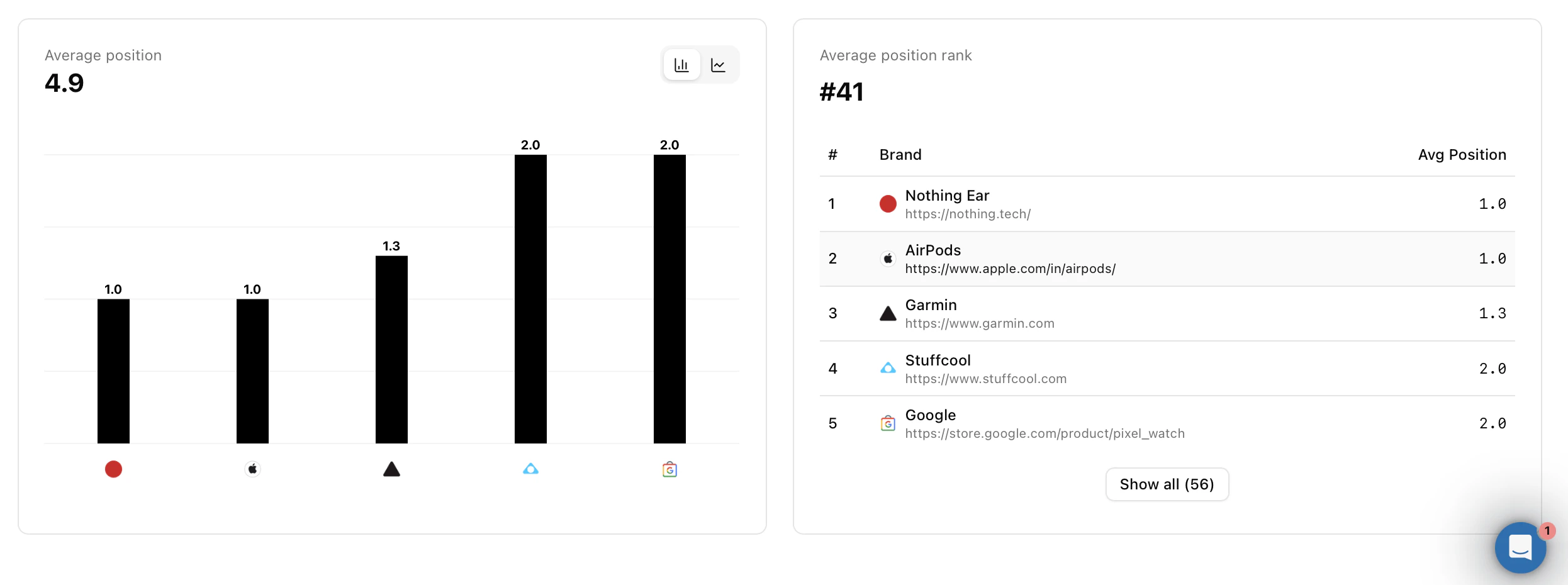
Where your brand ranks in the recommendation list.
What it is
AI models often provide answers in a list format (e.g., “Top 5 CRM softwares”). The Average Position tracks exactly where you land on that list. Unlike other metrics, a lower number is better here.How we calculate it
We scan every list-based answer where your brand appears and record the numeric rank.- Rank 1: You are the first recommendation (Best outcome).
- Rank 5: You are the fifth recommendation (Lower visibility).
- The Calculation: We average these rankings across all responses.
Why it matters
- Authority: AI models typically list the most trusted or relevant solution first. A position closer to 1 signals high algorithmic authority.
- Click-Through Rate: Users are significantly more likely to read and click on the first two options. If your Average Position is dropping (e.g., moving from 2.0 to 4.5), you are losing here.
4. Citation Share
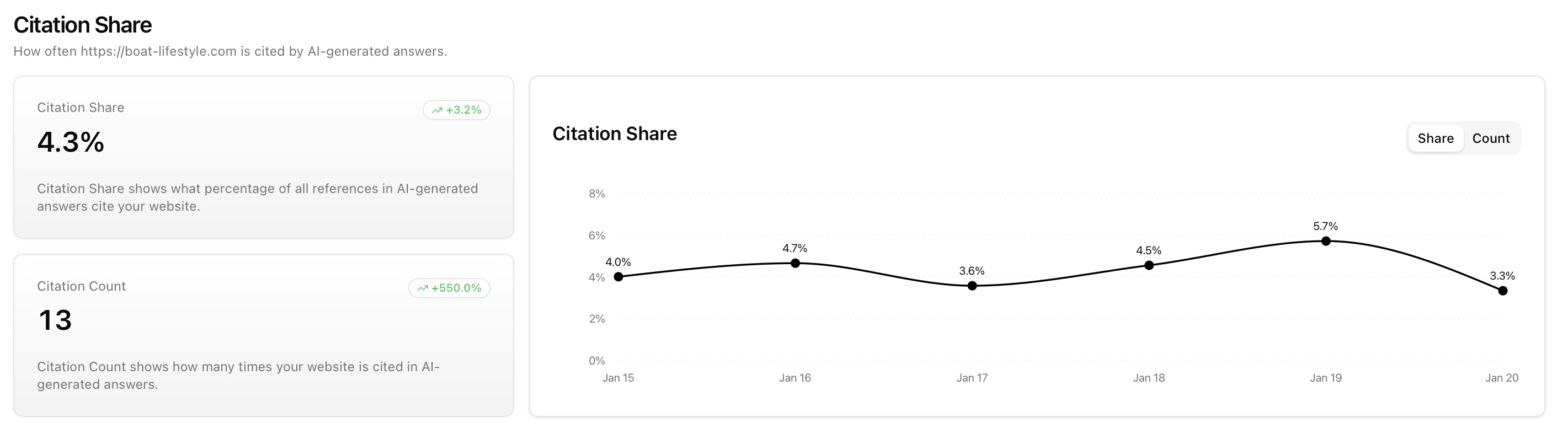
The frequency of direct links to your website.
What it is
Citation Share is arguably your most “actionable” metric for driving traffic. It measures how often the AI links directly to your website as a source of truth, rather than just mentioning your name.How we calculate it
We analyze the footnotes, “Learn More” sections, and embedded links in every AI answer.- The Metric: The percentage of all citations in the generated answers that point specifically to your domain.
- The Insight: The dashboard allows you to see exactly which pages (URLs) are being cited, such as your product pages or blog posts.
Why it matters
- Direct Traffic: A mention builds awareness, but a citation drives clicks.
- Content Strategy: If your Citation Share is low, it means the AI knows your brand name but is getting its information from third-party reviews or competitors rather than your own site. This signals a need to improve your website’s technical structure for AI scraping.