
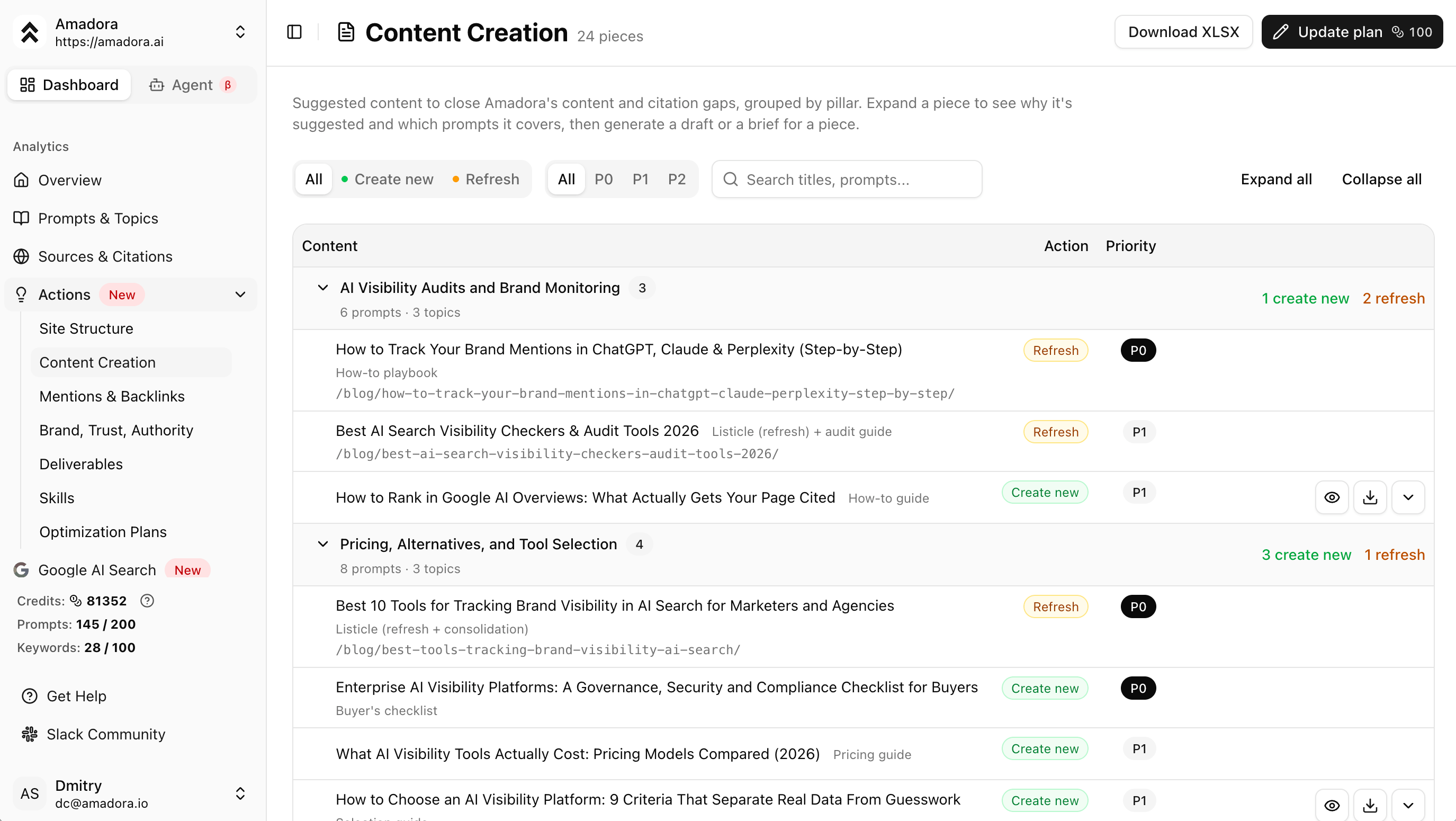
What Content Creation Does
Traditional content plans focus on keyword search volume rather than how AI models answer buyer questions. Content Creation analyzes tracked prompts where your brand is currently absent or losing visibility, ordering execution by commercial impact. The feature operates in a 3-step pipeline:- The Content Plan: Identifies exact content gaps and prioritizes publishing order.
- The Content Brief: Samples top cited URLs to build a citable H2 skeleton.
- The Blog Draft: Writes brand-aligned copy complete with quick-answer blocks and publishing metadata.
Plan Generation Logic
- Prompts-First Approach: Evaluates performance on tracked prompts rather than search volume alone. Prompts tagged as out-of-scope in your topical map are filtered out.
- Citation-Share Overlay: Combines prompt visibility gaps with competitor citation metrics.
- Format Selection: Analyzes the dominant cited source type (e.g., vendor page, listicle, forum, documentation) to determine optimal post format.
- Live Web Sampling (Briefs): Fetches the top 3 to 5 currently cited pages for a target query to derive structural requirements, schema, and required entities.
- Zero-Fabrication Guardrail (Drafts): Drafts reference your Brand Details. Missing metrics or anecdotes are flagged inline as
[PROOF NEEDED]rather than fabricated.
Priorities & Action Diagnoses
Priority Levels
- P0 (High Priority): Bottom-of-funnel prompts with 0% AI visibility and strong competitor citation share.
- P1 (Medium Priority): High-intent prompts with partial visibility or secondary feature gaps.
- P2 (Standard Priority): Educational topics and top-of-funnel search intent.
Action Diagnoses
- Create New: Content does not exist; requires building a new page from scratch.
- Refresh: Page exists but needs updating due to structural extraction issues, weak data, or stale content.
Deliverables & File Outputs
{Brand}_Content_Plan.xlsx
Contains four tabs: Content Plan (main schedule), Existing Blog (refresh diagnoses), LP Topics — Do Not Blog (routed architectural topics), and How to Use.2. Content Briefs
Writer-ready Markdown specs capped at 1,600 words.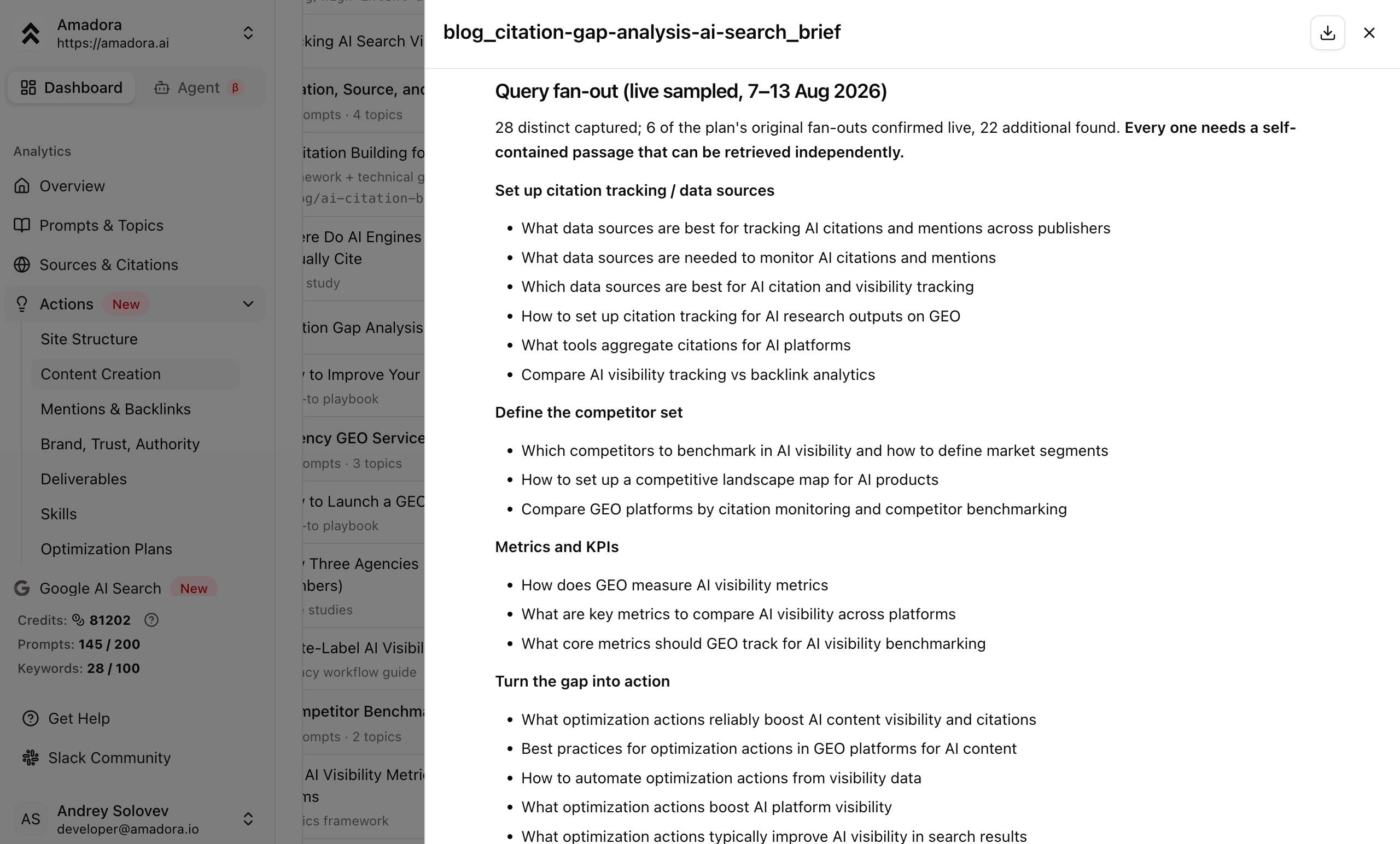
The blog draft
Drafts feature a quick-answer block within the first 200 words designed for AI extraction.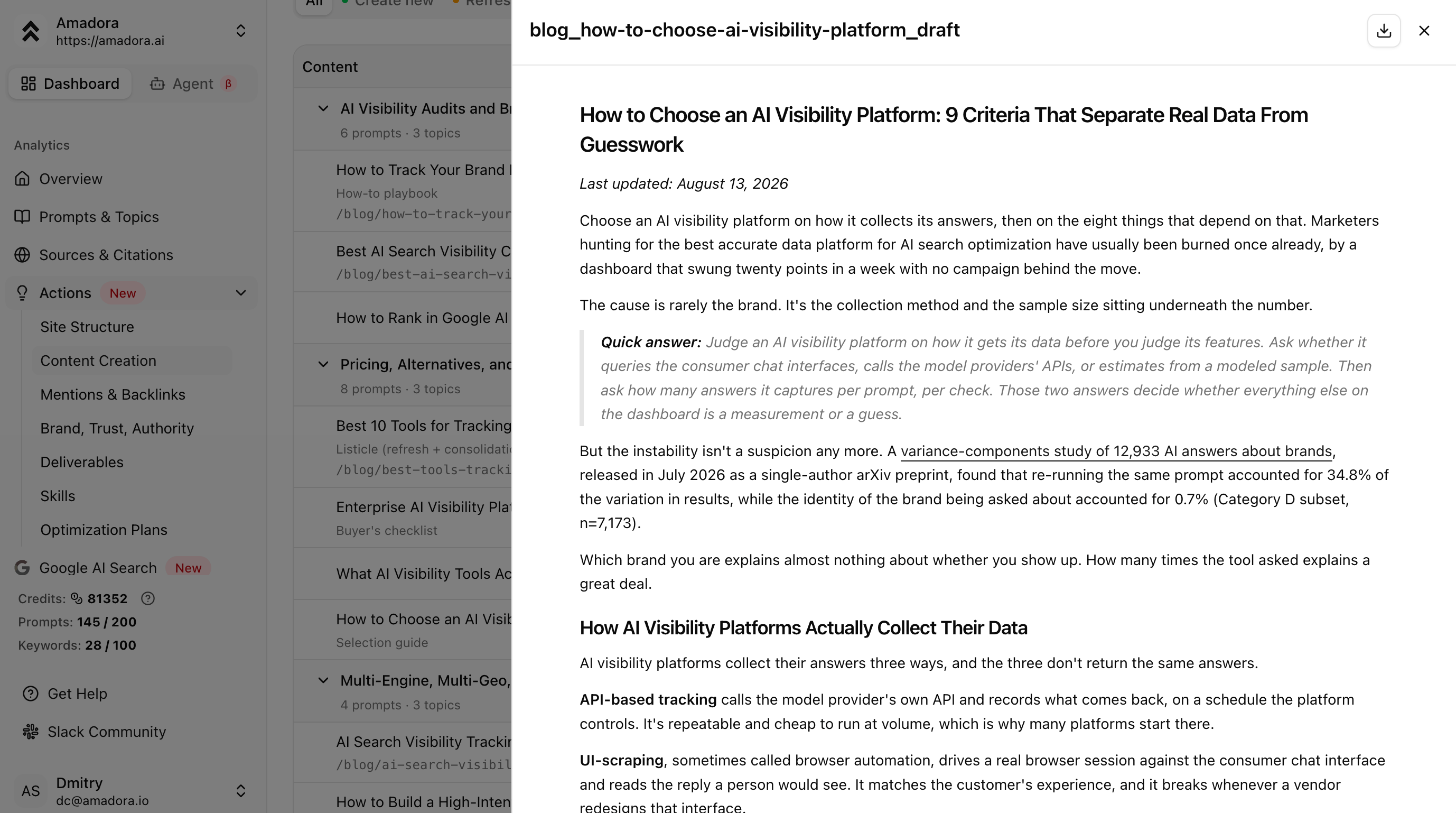
Execution Workflow
- Execute P0 Items First: Work through P0 creation and refresh recommendations in priority order.
- Generate Briefs On-Demand: Generate briefs right before writing to capture live web citation data.
- Generate Drafts or Hand Off: Convert briefs to blog drafts inside Amadora or assign the Markdown brief to a copywriter.
- Complete Proof Requirements: Resolve inline
[PROOF NEEDED]placeholders using verified company data. - Update Plan Status: Track publishing status and re-run Update plan periodically.
Updating Your Plan
Click Update plan (100 credits) to analyze your live sitemap for published articles and incorporate newly tracked prompts, keywords, or competitors. The update also flags published content remaining at zero visibility after 3+ weeks (indicating structural AI extraction issues).FAQs
Why is a specific topic missing from the plan?
Why is a specific topic missing from the plan?
It may be classified as landing-page intent (found on the LP Topics tab), merged with an overlapping prompt, or filtered out as an out-of-scope prompt.
Can I run Content Creation without tracked prompts?
Can I run Content Creation without tracked prompts?
Yes. The system will generate a plan using your topical map and live site data. Fan-out queries will be marked as projected rather than sampled captured answers.
Are blog drafts ready for immediate publication?
Are blog drafts ready for immediate publication?
No. Drafts are Markdown files containing
[PROOF NEEDED] placeholders that require human verification before publishing.